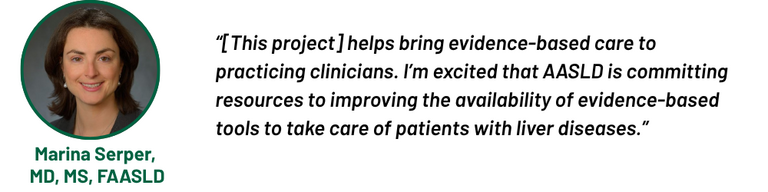
AASLD is proud to recognize Marina Serper, MD, MS, FAASLD as the inaugural recipient of the AASLD Project Innovation Award, marking a milestone moment in advancing member-driven innovation across the field of hepatology.
An Associate Professor of Medicine at the University of Pennsylvania and transplant hepatologist, Dr. Serper holds deep expertise in epidemiology, health services and patient research, and digital health. Her work focuses on improving outcomes for patients with cirrhosis, alcohol-associated liver disease (ALD), and those undergoing liver transplantation and is grounded in identifying gaps in care and developing solutions that translate into real-world impact.
The AASLD Project Innovation Award, supported by a generous anonymous donor through the AASLD Foundation, launched in 2025 and was created to fund innovative, member-led projects. The award provides both the resources and a structured pathway to elevate ideas with the potential to create meaningful impact across the field of hepatology.
As the first recipient of the AASLD Project Innovation Award, Dr. Serper is defining what this new initiative represents for AASLD and the member community.
Her selection reflects not only the strength of her work, but the broader potential of the award to elevate ideas that meaningfully advance liver health.
Elevating Member-Led Innovation
At the heart of Dr. Serper’s project is a simple but powerful concept: making it easier for clinicians to deliver evidence-based care at the point of need.
Developed in collaboration with the AASLD Practice Metrics Committee, the project centers on creating a digital practice toolkit to support clinicians caring for patients with liver disease in both inpatient and outpatient settings.
The toolkit will initially focus on hepatocellular carcinoma (HCC) and metabolic dysfunction-associated steatotic liver disease (MASLD), establishing a foundation for expanding evidence-based, digital clinical support across additional liver disease areas over time.
“This project came from a collective idea by the AASLD Practice Metrics Committee for a digital practice toolkit that would be useful to clinicians who take care of liver patients in the clinic and in the hospital,” Dr. Serper said. “This work helps bring evidence-based guidelines into clinical practice, which is really exciting.”
By translating clinical guidance into usable tools, it addresses a critical gap in hepatology: ensuring that evidence-based care is consistently implemented in everyday practice.
“I’m excited that AASLD is committing resources to improving the availability of evidence-based tools to take care of patients with liver diseases,” Dr. Serper said.
The result is a model for innovation that is not only forward-thinking, but immediately impactful: supporting clinicians and improving patient outcomes.
“My research focuses on identifying gaps in care and filling those gaps with multimodal innovative approaches. This project is very well aligned with both research and everyday practice,” she said.
Rooted in Collaboration & Community
Dr. Serper’s work is deeply rooted in collaboration across the AASLD community.
“Hepatology is a truly multi-disciplinary specialty and a team sport. Engaging with colleagues in the field to improve liver care at scale is really important,” she said.
“The AASLD Practice Guidelines and Practice Metrics Committees have been doing incredible work to identify best practices for liver disease care, and working with the Practice Metrics Committee has been a career highlight for me.”
Her project also brings increased visibility to the critical work of AASLD committees in shaping best practices and advancing standards of care.
From Innovation to Implementation
Dr. Serper’s selected project reflects a core goal of the Project Innovation Award: to support projects that innovate practice and improve outcomes across hepatology.
This award investment underscores how targeted funding can accelerate innovation and expand the reach of high-impact, member-led initiatives.
“While the concept was already underway, without the resources provided by the award, we would not have been able to start building the online tools,” Dr. Serper said.
With support from AASLD, the project can now move from concept to implementation, demonstrating how targeted, strategic investments in hepatology can elevate innovation and impact across the field.
Shaping the Future of Hepatology
Looking ahead, Dr. Serper sees significant opportunity to continue advancing the field through innovation, personalization, and collaboration. She is particularly energized by the evolution of more personalized and data-driven care models.
“I’m most excited by the concept of personalized care and the creation of a true learning health system to target population health, advanced therapeutics, and a continuous cycle of improvement,” she said.
Her perspective also underscores the importance of expanding innovation across the field.
“Consider how AI is shaping healthcare delivery as well as patient-centered approaches. Our project is clinician-focused. I hope to see projects that are patient- and community-focused in the future,” she said.
Inaugural Impact
As the first recipient of the AASLD Project Innovation Award, Dr. Serper represents the potential and the purpose of this funding investment.
“I’m excited that AASLD is committing resources to improving the availability of evidence-based tools to take care of patients with liver diseases,” she said.
Her work exemplifies the power of combining clinical insight, research, collaboration, and strategic investment to drive meaningful change, setting the stage for continued innovation across the AASLD community, the field of hepatology, and the future of liver health.